PairBrowse
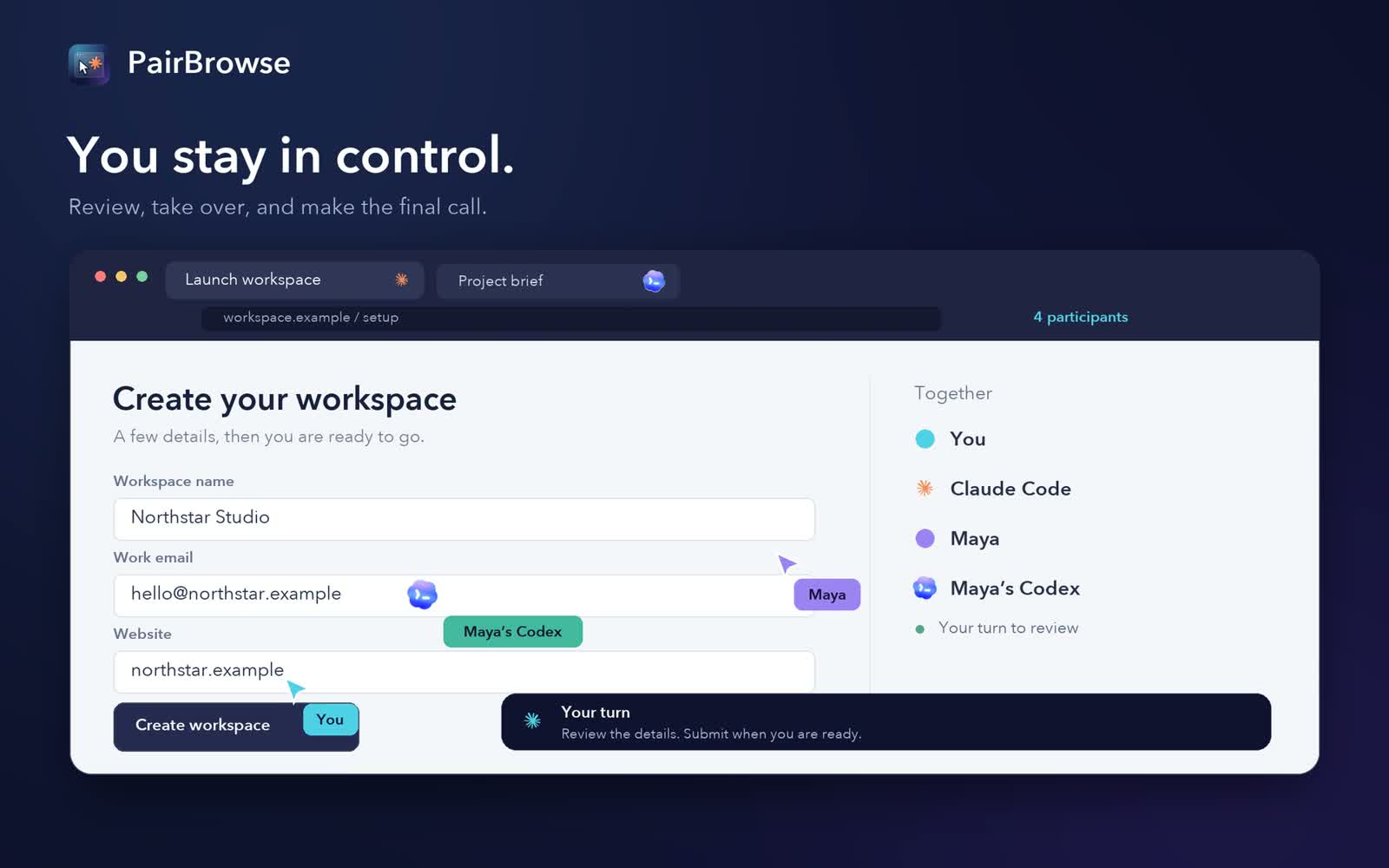
One live browser for you, your AI agent and your team. Claude Code or Codex drives the tabs, teammates join with their own cursor, and you take over whenever you want.
- Role
- Creator and lead engineer
- When
- 2026
The story
AI coding agents are good at code and bad at the web. They either drive a headless browser nobody can see, or stop and hand every form back to you.
PairBrowse puts the agent in a real, visible browser that you and your teammates share. I designed and built the plugin, the hardened Chromium runtime, the collaboration layer and pairbrowse.com.
Constraints
- Must work inside Claude Code and Codex, with no new app to learn.
- Websites must see an everyday browser, not an automation tool.
- People must stay in control of anything that pays, publishes, deletes or submits.
- Safe by default on real accounts: no exposed debugging port, no leaked passwords.
Decisions I made, and why.
A real, visible browser
A hardened Chromium driven over a private pipe instead of a debugging port, so only your user can reach it and you can watch every step.
A whole page per call
Fast mode fills fields, dropdowns and checkboxes and clicks next in one tool call, with no model turn between steps.
Humans confirm risky clicks
Pay, publish, delete, send and submit always wait for a person. CAPTCHAs are handed back, never solved.
Sharing without exposure
Teammates join with codes and their own cursor; localhost is shared through a tunnel with a key per joiner.
The trade-off
PairBrowse refuses to solve CAPTCHAs and stops for confirmation before risky clicks. Some flows are slower, but it is safe to point at real accounts, which is what makes it usable at all.
What I built
Human in the loop by design
Named cursors, shared tabs and a side panel that shows what the agent is doing. Risky clicks ask the user first; CAPTCHAs are always handed back.
Fast mode
A whole page (fields, dropdowns, checkboxes, next) in one tool call with no model turn between steps.
Share localhost without deploying
A Cloudflare Quick Tunnel to a local proxy, with a per-joiner key set as an HttpOnly cookie. Up to three dev servers at once.
Security as a feature
No debugging port, passwords scoped to domains and masked from the model, OpenSSF Scorecard and Best Practices, CodeQL on every change.
Results
- Released as open source under the MIT license.
- OpenSSF Scorecard and OpenSSF Best Practices, with CodeQL on every change.
- Works in both Claude Code and Codex.
Stack
- Node.js
- Chromium
- MCP
- Claude Code
- Codex
- Nuxt 4
- Cloudflare